
Import Contacts
You can add contacts to Sfax in bulk by uploading a comma separated value (CSV) file, instead of creating each one by hand. To download the contacts you already have, see Export Contacts.
Before You Start
- The address book. Every contact belongs to either My contacts, which only you can see and edit, or Shared contacts, which everyone on your account can see, edit and delete. You choose per row using the Contact Type column. Any row you leave blank is imported into My contacts.
- The name format. Every row in the file must use the same naming style: either first and last name, or full name. You cannot mix the two in one file.
Prepare Your CSV File
Your file can contain any of the fields below, in any column order. You match your columns to Sfax fields during the import itself, so you do not need to name or arrange them in a particular way.
Fields You Can Import
| Field | Contains |
|---|---|
| Fax number | The contact's fax number. Required. |
| Contact Type | Shared or My – which address book the contact goes into. Blank rows go to My contacts. |
| First name | First name. Use with Last name, not with Full name. |
| Last name | Last name. Use with First name, not with Full name. |
| Full name | The whole name in one column. Use instead of First and Last name. |
| Organization | Company, practice or group name. |
| Position | Job title. |
| Mobile number | Mobile number. Extensions are not supported here. |
| Phone number | Phone number. May include an extension. |
| Email address. | |
| Website | Website. |
| Description | Free-text notes about the contact. |
Number Formatting
- Fax number – 11 digits, for example 1-512-555-1212.
- Phone number – 11 digits, and may carry an extension, for example 1-512-555-1212 ext 123.
- Mobile number – 11 digits, and may not carry an extension, for example 1-512-555-1213.
Name Fields
Pick one naming style and use it for every row in the file. Whichever you choose, the other fields are switched off for those contacts in Sfax: if you import first and last names, the Full Name field is inactive; if you import full names, the First Name and Last Name fields are inactive.
Import Your Contacts
- Log into Sfax at https://app.sfaxme.com.
- Click the Contacts icon under the Sfax header, then click Import in the toolbar.
- In the Import contacts (Upload file) dialog, click Browse, select your CSV file, and click Open. The file name appears next to the Browse button.
- Click Next.
- In the Import contacts (Map import fields) dialog, tick First row is a header row if your file has column headings, so that row is not imported as a contact.
- For each column shown in the sample row, click the drop-down and choose the Sfax field it corresponds to – Fax number, Contact Type, and so on. Repeat until every column you want to import is mapped.
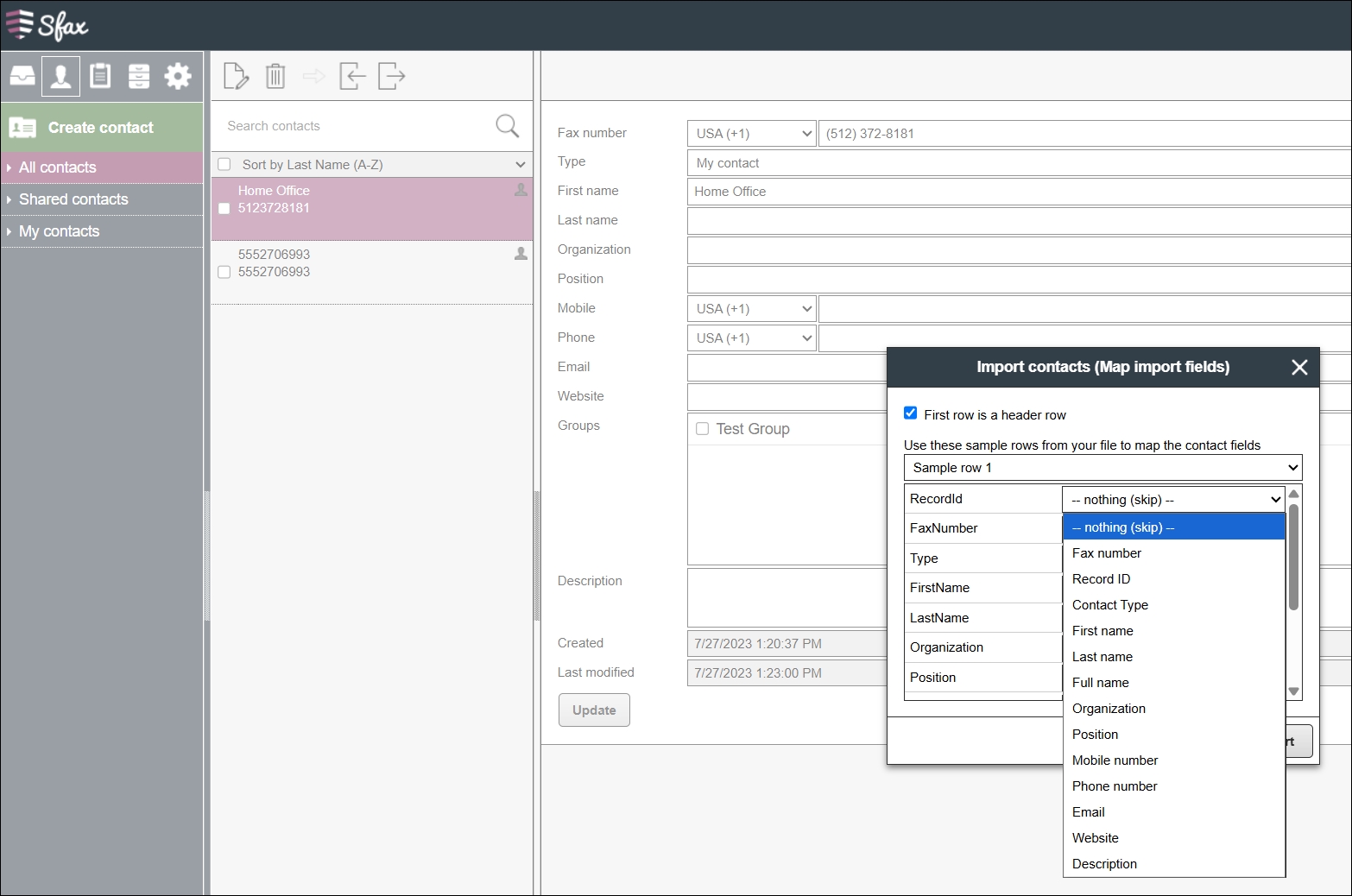
- Click Import. The Review Results dialog opens and shows how many contacts were added, updated, or failed.
- To see which contacts fell into each group, click the drop-down and choose New, Updated, or Failed.
- Click Close.
Working With the File In a Spreadsheet
Excel reformats number columns on the way in, and commonly strips the leading + and any leading zeros from fax, phone and mobile numbers. That breaks the 11-digit check and your file will be rejected..
Open Excel first, then use Data › From Text/CSV (or the Text Import Wizard), set the fax, phone and mobile columns to Text, and choose UTF-8 as the file origin so accented characters come through correctly.
Troubleshooting
| Scenario | Description |
| Nothing imported and I got an error | This is almost always number formatting. Sfax validates the fax, phone and mobile columns before importing, and rejects the entire file if any value is not 11 digits. Check that no numbers lost a + or a leading zero when the file was opened in a spreadsheet, correct them, and try again. |
| Some contacts show as Failed in Review Results | Click the drop-down in the Review Results dialog and choose Failed to see exactly which contacts did not import. These need to be created manually in Sfax – re-running the import will not pick them up. |
| Contacts went into the wrong address book
|
Check the Contact Type column in your file. It must read Shared or My; anything else, including a blank, is treated as My. Also note that importing cannot move a contact that already exists from Shared to My – to change that, edit the contact in the portal. |
| Names ended up in the wrong fields | A file has to use one naming style throughout: either First name and Last name, or Full name. Mixing them in the same file produces unpredictable results. Split the file into two imports if you have both kinds of rows. |
| Columns look misaligned in a file I exported from Sfax | A contact whose Description contains a line break is written across two rows when it is exported, which shifts every value after it into the wrong column. Open the file in a plain text editor to find the short row, repair or delete it, and remove the line break from that contact's notes in Sfax so it does not recur. See Export Contacts for how to avoid this before you export. |
Related Articles
Export Contacts
Download your contacts as a CSV file.